
LUMINA's Mission
A dedicated mission to measure, understand, and monitor artificial light at night.
The Invisible Problem
Artificial light at night, or ALAN, is one of the fastest-growing environmental pressures, yet it remains poorly measured. Existing satellite platforms like VIIRS and DMSP lack the resolution, spectral detail, and temporal cadence needed for real scientific analysis.
LED conversions have fundamentally changed the spectral character of the night sky, increasing blue-wavelength scattering and worsening skyglow in many regions. Without accurate evidence, the UK cannot shape effective policy, support biodiversity recovery, or quantify the real-world impact of modern lighting.
LUMINA fills this gap.
Empowering the Next Generation
LUMINA connects students, educators, and communities with real space science through our Schools Ground Station Program and hands-on learning opportunities.
Ground Station Network
Schools deploy Sky Quality Meters, becoming part of the national monitoring network and contributing real scientific data.
- • Optional hands-on sensor construction
- • Real-time data collection & analysis
- • Connection to national research network
- • Long-term environmental monitoring
Hands-On Learning
Students engage with authentic space science through building, deploying, and analyzing data from real sensors.
- • Build & deploy monitoring sensors
- • Learn data science & analysis
- • Understand light pollution impacts
- • Contribute to real research
Curriculum Integration
Flexible participation levels from full ground station operation to classroom data analysis projects.
- • Aligned with national curriculum
- • Access to open datasets & tools
- • Teacher resources & support
- • Multiple engagement pathways
Three Integrated Components
LUMINA is built on three integrated scientific components working together to create the UK's first comprehensive night environment dataset.
The CubeSat
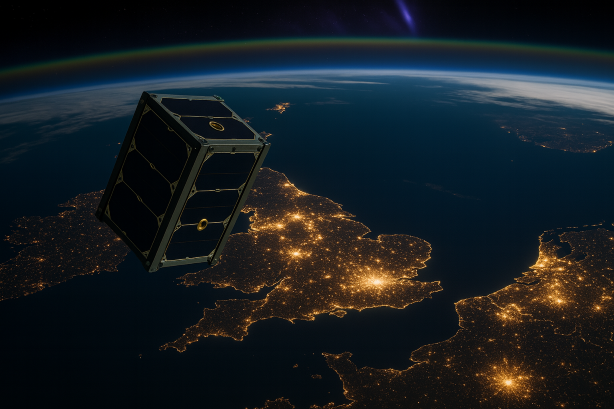
A compact 6U-class satellite designed to capture wide-field night-time radiance over the UK, measuring light intensity and spectral distribution with high temporal frequency.
- • Wide-field night-time radiance capture
- • Spectral distribution measurement
- • High temporal frequency orbital passes
- • Consistent calibration for national dataset
Ground Sensor Network
A distributed array of calibrated Sky Quality Meter (SQM) nodes providing local truth, validating and enriching satellite measurements.
- • Zenith brightness measurement
- • Spectral characteristics analysis
- • Temporal variation tracking
- • Environmental context monitoring
The Data System
A unified, transparent data architecture flowing from raw to calibrated to validated to published, with open-access research APIs and public dashboards.
- • Transparent data pipeline
- • Open-access research APIs
- • Public engagement dashboards
- • Full reproducibility and traceability
Our Research Goals
LUMINA's objectives are framed around scientific intent, ensuring all data meets peer-reviewed standards with calibration, validation, and transparent documentation.
Sky Brightness & Distribution
Map artificial light across the UK at unprecedented detail to identify patterns, hotspots, and changes over time. This foundational data enables all other research applications.
Spectral Character
Distinguish between lighting technologies and quantify blue-rich emissions that drive skyglow and ecological disruption. Understanding the "what" behind the light.
Temporal & Seasonal Behaviour
Understand how lighting behaves daily, weekly, and seasonally — tied to human activity, infrastructure, and policy interventions. The "when" and "how" of night-time lighting.
Scientific Integrity
All data must meet peer-reviewed standards, with calibration, validation, and transparent documentation. This cross-cutting objective ensures LUMINA becomes trusted and authoritative.
Transforming Research & Policy
LUMINA will support research and action across nine key domains, transforming it from "a science project" into a national environmental asset.
Ecology & Biodiversity
Understanding how ALAN affects wildlife, migration patterns, and ecosystem health.
Human Health & Wellbeing
Researching the impacts of light pollution on circadian rhythms and sleep.
Climate, Energy & Sustainability
Quantifying energy waste and carbon footprint of inefficient lighting.
Policy, Planning & Governance
Providing evidence for local and national lighting policies.
Transport, Safety & Infrastructure
Balancing safety needs with environmental protection.
Education & Citizen Science
Engaging the public with real space science data and STEM learning.
Industry & Innovation
Supporting smart lighting solutions and economic analysis.
Cultural Heritage & Dark Skies
Preserving dark skies for cultural, astronomical, and heritage value.
Research & Academic Collaboration
Enabling peer-reviewed research and international scientific partnerships.
Vision & Legacy
LUMINA is not a short-term mission. Its long-term goal is to provide continuous, scientifically credible monitoring of the UK night environment - enabling environmental protection, smart urban planning, energy efficiency, public understanding, academic insight, and international leadership.
"By making the invisible visible, LUMINA will help the UK understand and protect one of its most undervalued natural resources: the night itself."
Join the Mission
LUMINA is a science-first national capability. We're building partnerships with councils, universities, NGOs, and agencies to make this vision a reality.